
 Italiano
 Français
 English


The history of the ruling pen and of the Handwritmic ruling pen.
The history of the ruling pen and of the Handwritmic ruling pen.
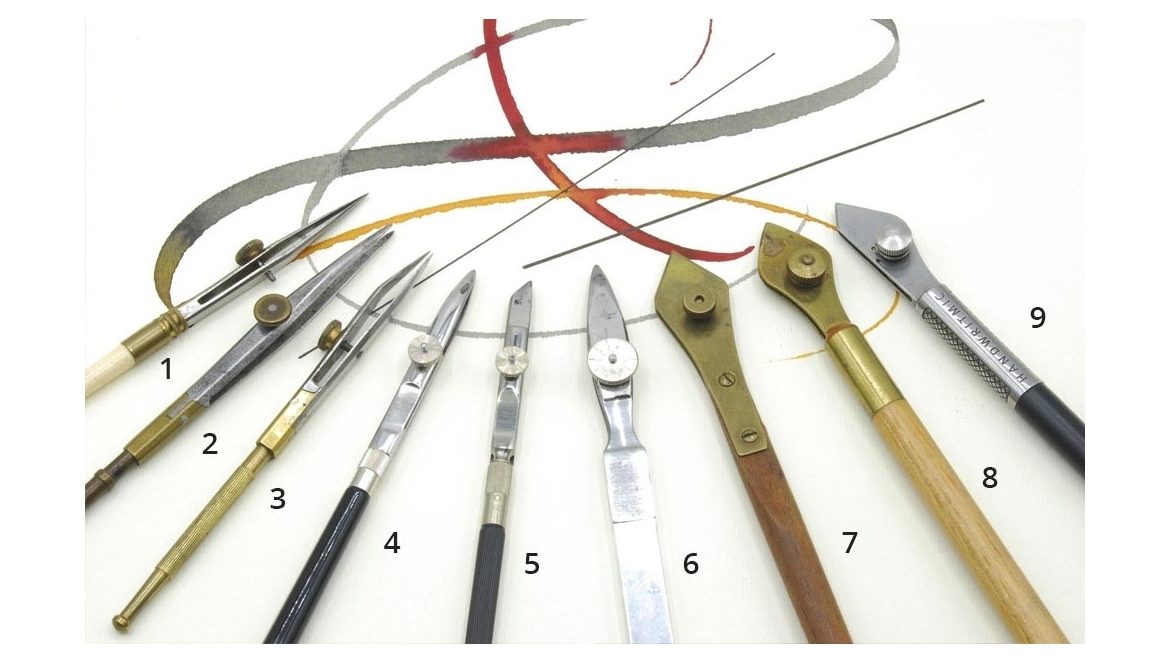
The ruling pen is an instrument with a long history that was certainly used already in the eighteenth century if not even before (see n. 1, 2 and 3 on the photo above), as demonstrated by a document found by chance on the occasion of an exhibition about the life
The history of the ruling pen and of the Handwritmic ruling pen.
The ruling pen is an instrument with a long history that was certainly used already in the eighteenth century if not even before (see n. 1, 2 and 3 on the photo above), as demonstrated by a document found by chance on the occasion of an exhibition about the life and work of an architect and engineer named Antonio Bertola (1647-1719), who was responsible for some works in Piedmont, including the fortification works of Turin.
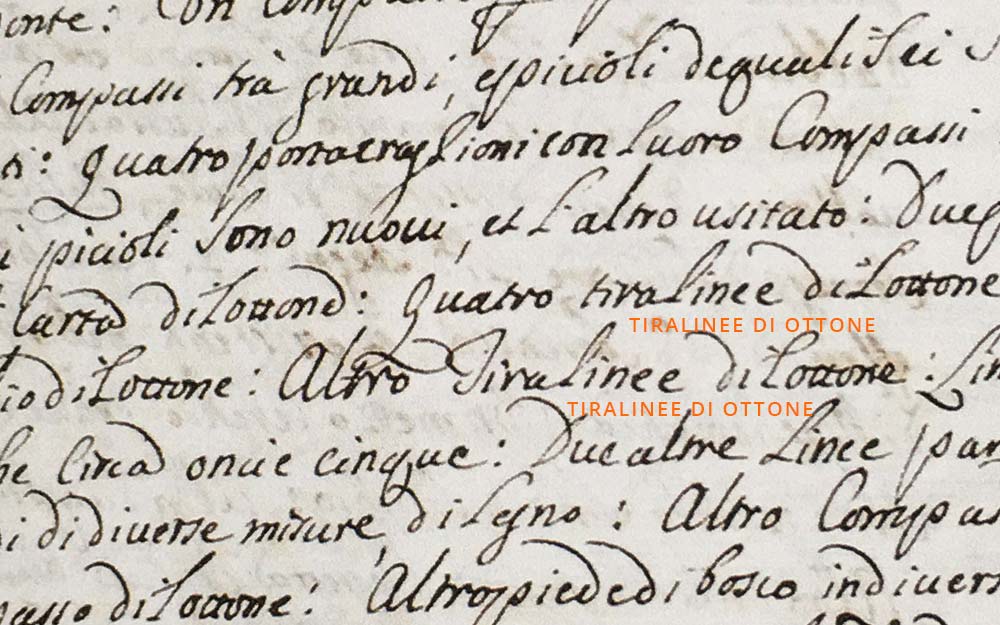
The document is a will from 1715 which includes a list of the tools of Bertola's trade, and among these there are several examples of ruling pens. It is a curious coincidence that Bertola was born in Muzzano in the province of Biella and Handwritmic, producer of the Brody Neuenschwander ruling pen, is a company from Biella.
But what was the function of this tool? It was used to draw lines of various thicknesses for technical drawing. After loading the instrument with gouache or India ink with the help of a brush, opening or closing the gap between the two blades, various line thicknesses could be obtained. Until the 1930s, until graphos took over and, subsequently in the 1950s, rapidographs, there was no other way to trace lines of various thicknesses. The ruling pen like n. 4 on the photo, with the black plastic staff, is a typical model that could be found in technical offices until not long ago. In Italy the ruling pen remained in circulation for many years, more out of habit than for a real function: it was in fact found in all compass sets. Until a few years ago it was still produced in Germany in different variants, for example with opening blades (for better cleaning) or with a much longer and more tapered tip.
Anyone who owns one is lucky because these instruments are now discontinued in Europe, they are only made in China. Calligraphystore has finished it's stock. Calligraphystore also made an interesting variant, inspired by model n. 5, found by Anna Ronchi among the stock of an old Italian stationery shop. This is an incredible oblique cut tip model, which can be held very vertical for wide strokes, while the corners are good for making thin lines. Very useful for calligraphy is the 'Swedish ruling pen', much coveted by calligraphers (n.6 on the photo) because the wider tip allows you to draw thicker strokes. The flat handle, however, makes it very uncomfortable to hold.
But who introduced the use of the ruling pen in calligraphy? It was Friedrich Poppl (1923 – 1982), german calligrapher and type designer, who one night way back in 1956, overcome by tiredness, with a spontaneous gesture dipped the ruling he had at hand directly into the bottle, thus creating a stroke so new and interesting that he never stopped using it. From that moment his father-in-law created some modified versions of the ruling pen for him, with wider blades, capable of holding more ink and suited to his needs. Then other german calligraphers such as Schneider and Pott adopted the ruling pen as their favourite writing instrument and introduced it to North America where Laurie Cook began the production of the so-called ruling writer, which is now a must in every calligraphers' case. The closest model to this is what is produced today by The Pen Artisan (see n. 8). The number 7 was made in Germany by a craftsman, up to the year 1990 - 2000.
In recent years, Paul Shaw has found out that several american lettering artists of the New York school of the 1920s have created interesting 'script' characters with none other than ruling pens. They were passionate about this instrument because it has some similarities with a brush, compared to which the width of the stroke is more under control while maintaining freedom of movement.
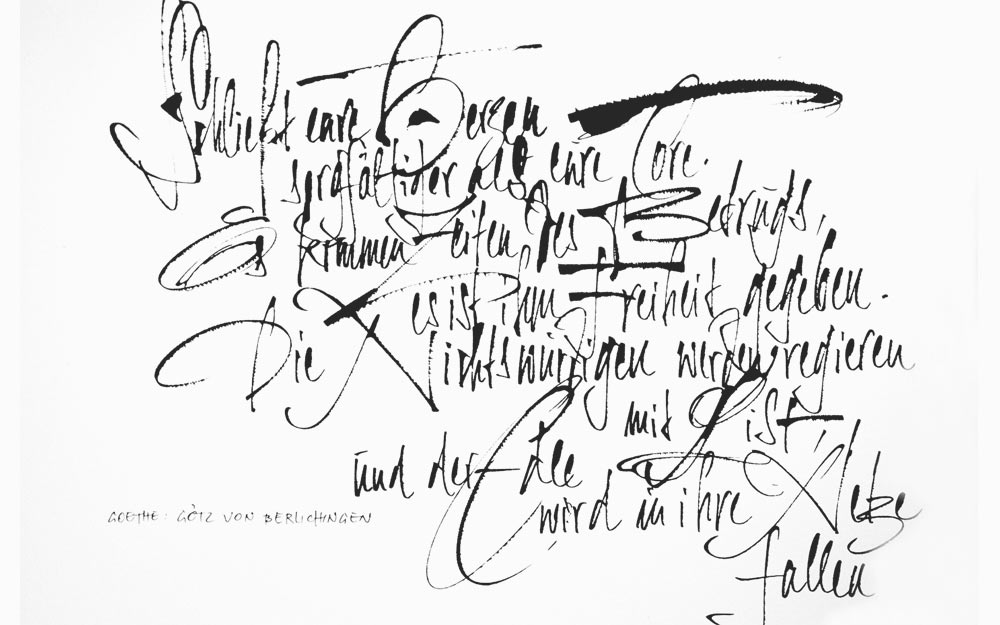
The Handwritmic ruling pen, on the other hand, has been in production since 2016. Brody Neuenschwander gave his name to it when he was able to try it firsthand. His signature is engraved on the grip area of the pen. This is his comment: “Magnificent! Fabulous! What a joy to write with! It makes the most beautiful splatters, feels good in the hand, is a lovely object to see”. Initially the pen was gold in color (see page below, created by Karl Rohrs), following a particular surface treatment, which was then abandoned due to technical complications. There are still some photos of this ruling pen on the internet, showing that some people own it since a very long time. This pen, created with the aim of making it suitable for a wide audience, has a new original asymmetric shape that facilitates pen holding (similar to that of a dip pen). The result is a new calligraphy and drawing instrument with four functions: you can write bold, medium and thin strokes and you can rule lines of different thicknesses holding the pen vertically.
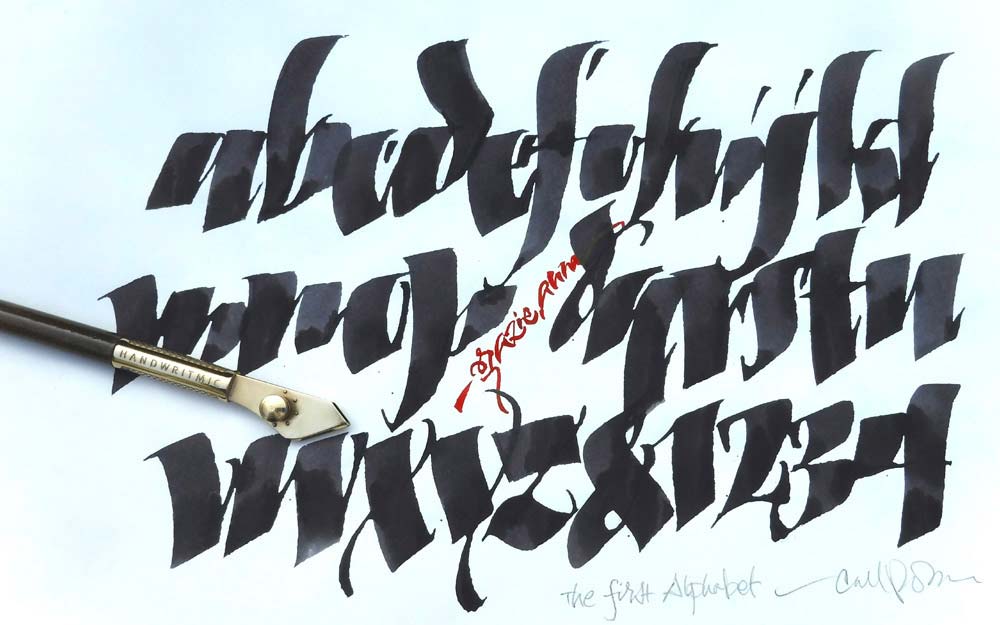
It goes without saying that the calligrapher must forget the rules of formal calligraphy to be able to write with this kind of pen. It is therefore necessary to explore new techniques, with a different ductus, angles and movements (even from bottom to top). This pen is perfect for expressive, even wild calligraphy. Splashes occur quite naturally but can also be induced by strokes from bottom to top with adequate pressure.
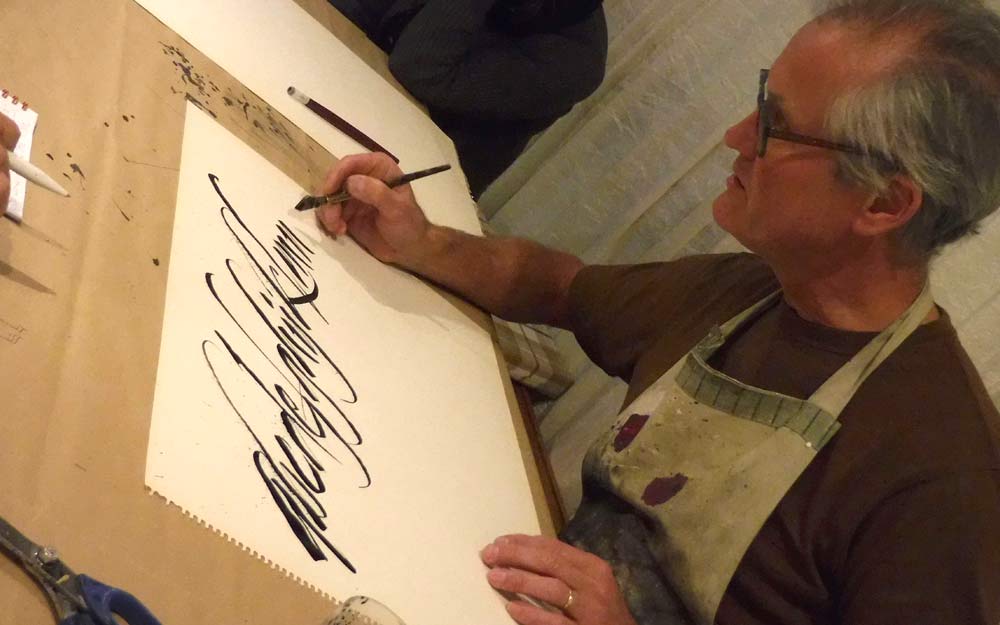
If the ruling pen was once a tool used by graphic designers and lettering designers, today the modern ruling pen can be used to draw very freely, as such artists as Stefano Bonora (see two portraits below) or Ali Sabet have demonstrated. The BN ruling pen Handwritmic is certainly not as soft and flexible as a brush and yet it can be pushed or pulled when writing and can be rotated and turned in all directions; it can write with the tip or it can rest more down on the paper, with little or a lot of pressure; everything is possible both in the hands of an expert artist or of a student.

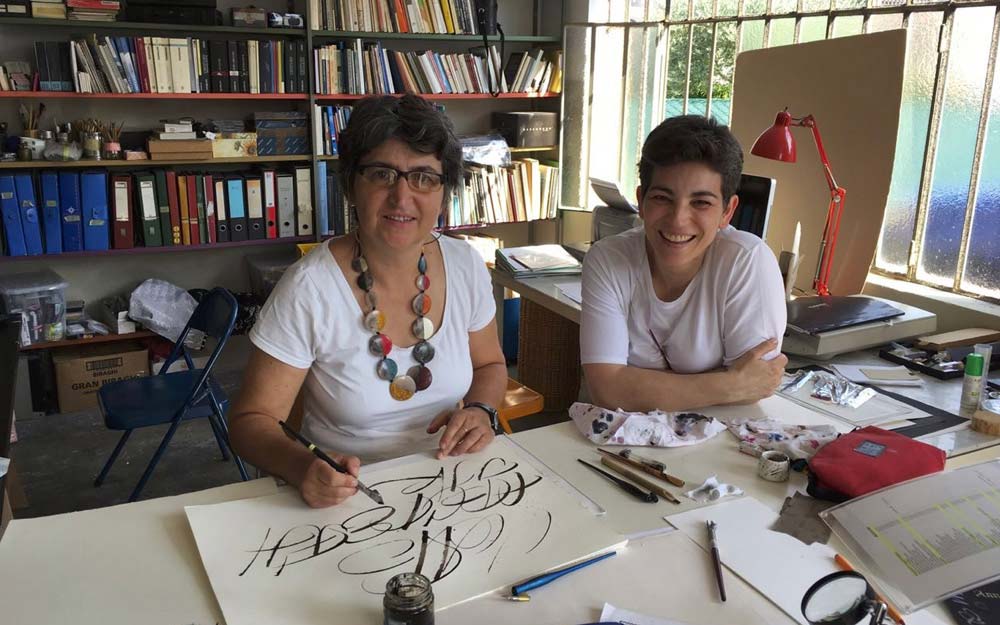
We take this opportunity to dispel a myth: the ruling pen was not designed by Brody Neuenschwander, but by Anna Ronchi (calligrapher), here in the photo (to the left) with Maria Eugenia Roballos, and by Domenico Rizzini (technician). Each of the two has contributed with their know-how to the creation of this wonderful pen which is about to turn 10 and which probably represents the first contemporary calligraphy tool produced in Italy since the golden days of compasses and lines, a sector in which Italy was a leader with a district in the province of Bergamo.
Comments
No comment at this time!
Leave your comment